
How Recurring Membership Billing Works With Stripe, and Why It Costs Less Than You Think
How WeLoyal membership billing works with your own Stripe account: payments go straight from customer to business with no extra platform fee layered on every charge.

WeLoyal is a digital loyalty card platform that connects directly to a business's own Stripe account to power recurring membership billing, meaning payments travel straight from the customer to the business's bank account without an additional platform fee sitting on top of every single charge. For any business considering a membership card, understanding exactly how the billing actually works, and why the specific mechanism of connecting your own payment processor matters financially, is worth genuine attention before launching a program that customers are going to be charged on every single month. This post walks through the entire mechanism in depth.
Why the payment connection itself is the most important design decision
Plenty of membership and subscription apps exist that handle billing on a business's behalf, but many of them do so by routing every single payment through their own merchant account rather than the business's own, and quietly marking up the processing rate along the way as part of how the platform makes money. This might look identical to a business owner glancing at a single transaction, but multiplied across hundreds of members paying every single month, that markup compounds into a genuinely significant amount of revenue leaking out of the business over the course of a year, money that would otherwise have simply stayed with the business.
Connecting a business's own Stripe account directly avoids this entirely. Once connected, every membership charge travels a direct path, from the customer's card straight into the business's own Stripe balance, and from there straight into the business's own bank account, on whatever payout schedule Stripe is configured to use. The loyalty platform isn't sitting in the middle of that payment flow taking a percentage of transaction volume, it's simply the system that tells Stripe when to charge, how much, and to which tier a given member belongs. The only costs involved become Stripe's own standard processing fee, the same fee essentially any business already pays to accept card payments in any context, and the loyalty platform's own flat subscription cost, with nothing extra layered on top of the membership revenue itself.
Setting up the connection
Connecting a Stripe account happens once, through the account's payment settings, entering the public and secret keys found directly inside a business's own Stripe dashboard. Once that connection is confirmed, membership cards unlock the ability to collect real payment at the point of setup, rather than existing purely as a free, manually tracked club pass with no billing behind it at all.
Building pricing tiers on top of the connection
With Stripe connected, a business builds out its actual membership tiers, each with its own name, price, billing period, and, where relevant, a visit or usage allowance attached to it. A gym might build a lower-priced tier with a capped number of monthly classes and a higher-priced tier with unlimited access plus extra perks. Each tier can be individually enabled or disabled, letting a business launch with a simple structure and add more tiers later without needing to rebuild anything that's already live.
What actually happens once a customer subscribes
The moment a customer signs up for a paid tier, Stripe's own subscription billing infrastructure takes over the recurring side of things entirely. Charges fire automatically on the agreed schedule, whether that's monthly, quarterly, or whatever billing period the business has set. If a payment fails, for an expired card or insufficient funds, Stripe automatically attempts retries following its own standard, well-tested logic, exactly the same reliable infrastructure a huge share of the world's subscription businesses already depend on. None of this needs to be built, monitored, or manually managed by the business itself, it simply runs, quietly, in the background, the way billing infrastructure is supposed to.
Trial periods and promo codes
A free trial period can be attached to any membership tier, letting a new sign-up use the service for a set number of days, anywhere from a single day up to a full month, before their first actual charge goes through. This meaningfully lowers the barrier for someone who's interested but not yet certain enough to commit financially on day one, letting them experience real value before being asked to pay for it. Promotion codes can also be applied at the checkout stage, useful for launch discounts, referral-driven signups, or limited-time offers designed to convert someone who's still sitting on the fence.
Why prices lock in for existing members once a tier goes live
Once a specific tier has active, paying subscribers, its price locks in for anyone already subscribed at that rate. If a business decides later to raise prices, existing members continue paying exactly what they originally signed up for, while the new, higher price only applies to new members joining after the change takes effect. This isn't a limitation of the loyalty platform specifically, it's simply how serious subscription billing infrastructure is built to work, and it protects the trust a business has built with its earliest, most loyal members rather than surprising them with an unexpected price increase on something they already committed to in good faith.
Visit tracking within a billed membership
For membership tiers that include a usage limit rather than unlimited access, a defined number of classes or visits per period, the platform tracks and decrements that allowance automatically every time a member checks in, resetting cleanly at the start of each new billing cycle without anyone needing to manually count or reset anything by hand. Tiers without a limit simply track visit counts for the business's own analytics purposes, without capping access at all.
The financial reporting this connection makes possible
Because billing runs through a business's own connected Stripe account, the dashboard behind the membership card can surface genuine subscription-business metrics rather than vague estimates. Total revenue generated by the program. Monthly recurring revenue, representing predictable baseline income before any other business activity is even factored in. Average revenue per subscriber. Lifetime value calculated specifically for membership customers, accounting for typical subscription length. And churn, showing exactly how many members are cancelling over any given period, alongside how many new members are joining in the same window. A dedicated payments view breaks all of this down further, with visual trends over a selectable date range and a full, detailed transaction table underneath for anyone who wants to inspect individual charges directly.
What this means in practice for a real business
A business running a membership program with its own connected Stripe account gets the exact same recurring billing reliability as a major subscription company, automatic charges, automatic retries, secure payment handling, without paying an unnecessary markup on every single transaction just because a third party happened to be sitting in the payment flow. Over a meaningful base of monthly subscribers, that difference compounds into real money that stays with the business rather than quietly leaking out to a platform fee most business owners never think to look for until they've already been paying it for years.
At a glance: how Stripe-powered membership billing works
The core mechanism:
- A business connects its own Stripe account directly
- Payments travel straight from customer to business, with no added platform markup
- Only costs involved are Stripe's standard processing fee and the platform's flat subscription cost
What Stripe handles automatically:
- Recurring charges on the agreed billing schedule
- Automatic retries on failed payments
- Secure, industry-standard payment processing
Pricing flexibility:
- Multiple tiers, each with its own price, period, and benefits
- Tiers can be individually enabled or disabled
- Free trial periods from one day up to thirty days
- Promo codes available at checkout
Pricing protection:
- Once a tier is live, existing members keep their original price
- New pricing only applies to new members joining after a change
Reporting available:
- Monthly recurring revenue
- Average revenue per subscriber
- Membership-specific lifetime value
- Churn and new member trends over any selected period
Read more
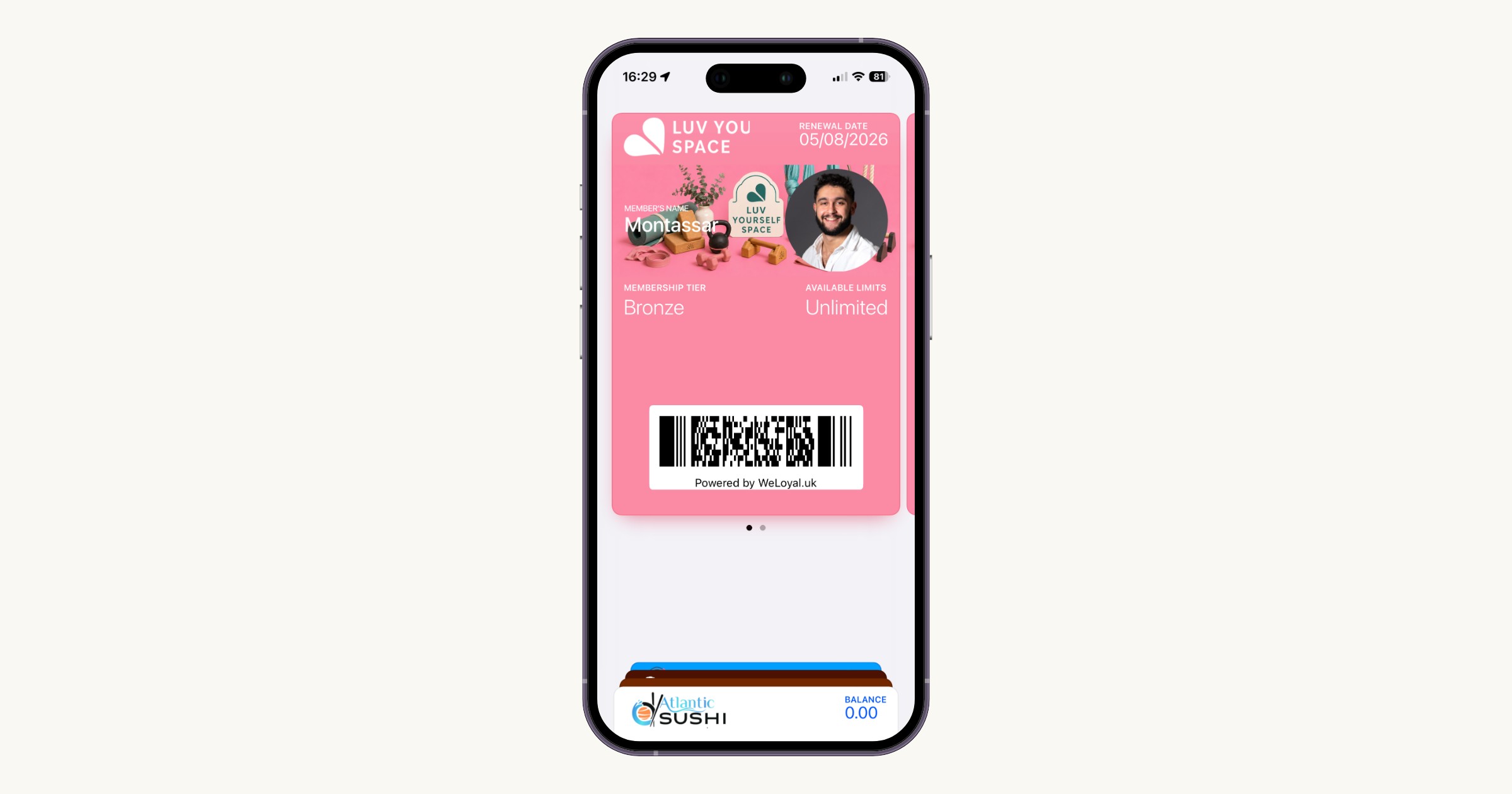
The Membership Card: Turning One-Off Customers Into Predictable Monthly Revenue
WeLoyal membership cards connect to your payment processor to bill customers automatically each month, the way a gym or subscription service does.

Digital Loyalty Cards for Coworking Spaces: Managing Members, Day Passes, and Recurring Revenue in One Place
How WeLoyal helps coworking spaces manage day passes, visit bundles, and full recurring memberships in one system, delivered straight to Apple Wallet and Google Wallet.

How to Build a Tiered Membership Program for a Gym, Studio, or Salon
A step-by-step guide to building a tiered membership program for a gym, studio, or salon with WeLoyal: how many tiers, visit allowances, pricing, and benefits per tier.